The Face on the Call: Separating Identity Checks From Skills Checks in UK Hiring
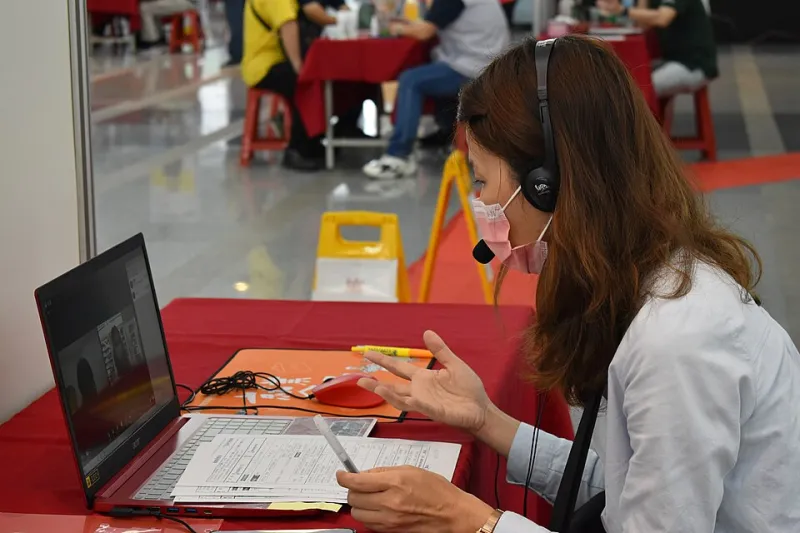
Photo: 臺中市政府勞工局, Attribution, via Wikimedia Commons
Most hiring processes were designed around a simple assumption: the person on the video call is the person in the CV. That assumption is now doing more work than it can bear. Recruitment teams in the UK report candidates whose video presence does not match their documentation, candidates who answer questions with a half-second delay that suggests they are reading, and candidates whose references resolve to people who have never heard of them.
The response that suggests itself — buy a verification tool — tends to produce a new problem rather than solving the old one. Identity assurance and skills assessment are different questions, answered by different evidence, and confusing them leads to processes that are either intrusive without being useful or thorough-looking without being thorough.
Two questions, deliberately kept apart
The first question is whether the person you are speaking to is the person they claim to be. The second is whether that person can do the job. A candidate can pass the second convincingly while failing the first, and a candidate can be entirely genuine while being a poor fit. Neither check substitutes for the other.
Keeping them separate matters for fairness as much as for security. Identity checks applied unevenly, to some candidates and not others, create both legal exposure and a recruitment experience that candidates talk about. A published, consistent sequence — verification at a defined stage, assessment at another — removes discretion from the process and reduces the risk of a check being applied because of how someone sounds or where they were born.
What the video call can and cannot tell you
A video call is a weak identity signal. It shows a face and a voice, both of which can now be synthesised or substituted in real time with modest technical effort. Liveness cues that felt reliable two years ago are no longer reliable, and interviewers should not be asked to make identity judgements from demeanour.
What the call can do is test capability. Ask questions whose answers cannot be prepared in advance — a walk-through of a decision the candidate personally made, a disagreement they handled, a piece of work they would now do differently. Ask for specifics and follow the thread. Fabricated experience tends to survive the broad question and collapse under the third follow-up.
Where a role is high-trust or remote-first, consider a structured verification step before the final interview: a document check conducted on camera against the original, or a verification provider that returns a confidence level rather than a yes. Whatever you choose, apply it to every candidate for the role, and write down what you will do with a marginal result.
Right to work is not identity assurance
There is a persistent misunderstanding here, and it is worth correcting plainly. A right-to-work check establishes that someone is permitted to do the work. It is not a general identity guarantee, and it does not confirm that the individual holding the documents is the individual who will turn up.
Employers in the UK must prevent illegal working and can establish a statutory excuse by conducting checks in the prescribed manner before employment begins. Since the shift to eVisas, many checks for non-British or Irish nationals are conducted online using a share code, and Identity Document Validation Technology is permitted for specified document groups. Guidance changes; confirm the current Home Office position before you redesign a process, and keep dated records of the checks you performed and the method used.
Conduct the check at a defined point, retain what you are required to retain for as long as you are required to retain it, and avoid holding copies of documents you do not need. Document images are personal data, and a shared drive full of passports is a liability rather than a filing system.
If you use biometric or identity-verification technology
Some verification tools process facial images or voice samples to confirm that a live person matches a document. Under UK GDPR, biometric data processed for the purpose of uniquely identifying an individual is special category data, which means you need a lawful condition beyond ordinary legitimate interests, a data protection impact assessment, a documented retention period, and a clear explanation to candidates of what is processed and why. Check whether the provider stores templates or images, where processing occurs, and what happens to the data if the candidate withdraws.
A cheaper and often better alternative is a human check: a scheduled call in which a member of staff asks the candidate to hold their ID beside their face and confirms the details aloud. It is not elegant, but it is auditable and easy to explain.
Decide now what happens on discovery
Most organisations discover a problem mid-process and improvise. The improvisation usually involves a withdrawn offer, an awkward conversation and, occasionally, a claim that the process was unfair.
Decide in advance, with HR and legal input, on three scenarios. First, a candidate who cannot evidence identity at the verification stage: the offer is not made, and the reason is recorded factually. Second, an offer made on a conditional basis where a condition is not met: the condition was written into the offer letter, so withdrawal follows the contract rather than sentiment. Third, a discovery after the start date: an investigation, a pause on duties where appropriate, and a decision made against the contract and your disciplinary procedure rather than in the moment.
Write these into the recruitment policy in plain sentences and make sure the hiring manager has read them before the first interview, not after the first surprise.
A working checklist
- Publish the sequence: when identity is verified, when skills are assessed, who decides.
- Verify identity before the final interview for high-trust and remote roles, applied to every candidate.
- Run right-to-work checks in the prescribed manner before the start date, and record the method and date.
- Give candidates a named contact for questions about verification, so the process does not feel like an accusation.
- Retain only what you need, for as long as you need it, and delete on schedule.
- Brief interviewers on liveness red flags without turning them into amateur investigators.
- Write the three discovery scenarios into policy, with named decision-makers.
Recruitment fraud is not solved by suspicion. It is solved by a sequence that everyone understands, evidence that is recorded at the time, and a plan for the awkward conversation that does not depend on inventing one under pressure.